
Children’s Environmental Health Month Comes to New Hampshire: How Climate Change Affects our Kids and What We Can Do
Did you know that October is Children’s Environmental Health Month? While the month recognizes a broad array of environmental concerns for kids, NH Healthy Climate worked with communities, healthcare organizations and the general public to raise awareness about how fossil fuel emissions and our changing climate affect our children in particular. As a result, seven communities signed Proclamations recognizing Children’s Environmental Health Day on October 8th, including Manchester, Nashua, Rochester, Dover, Exeter, Portsmouth and Plymouth, joining the NH Chapter of the American Academy of Pediatrics (NHAAP), the NH Academy of Family Physicians (NHAFP) and the State of New Hampshire!
So what are some of the impacts of climate change on kids in this state? Increasing exposures to tick- and mosquito-borne illnesses, increasing incidence of respiratory distress (such as asthma) from air pollution and wildfire smoke, especially on very hot days, and increasing emergency department visits for heat-related illness and injuries are just some of the impacts.
Paul Friedrichs, M.D. notes that “air pollution from fossil fuels is responsible for ~1 in 5 deaths worldwide; around 7 million deaths per year. It’s especially dangerous for young children, whose organs and immune responses are still developing and who breathe more relative to body weight than adults.” He adds that “children under 5 bear 88% of the global burden of disease due to climate change. “ In addition, very young children have smaller airways and less developed lung capacity, increasing the impacts of poor air quality.
Why are children more vulnerable to climate change related impacts? Speaking of vulnerability to heat, Dr. Thomas Walsh, a Pediatric Hospitalist at Dartmouth Medical Center, explains that “it has to do with their body mass to surface area ratio, which is smaller for kids than adults. Kids tend to heat up and get dehydrated more quickly as a result. They may also be less responsive to body cues such as thirst.”
The impacts of climate change on kids are so concerning that the American Academy of Pediatrics crafted a policy statement on climate change and children’s health. In addition to noting the harms of climate change for kids, this statement also describes how certain climate change solutions-policies that reduce reliance on fossil fuels, that facilitate walking and bicycling, encourage more sustainable diets, increase access to nature, and foster connected communities-can lead to immediate and long term gains in child health and equity.
So what can we do in our everyday lives, here in New Hampshire, to reduce impacts for kids and our climate?
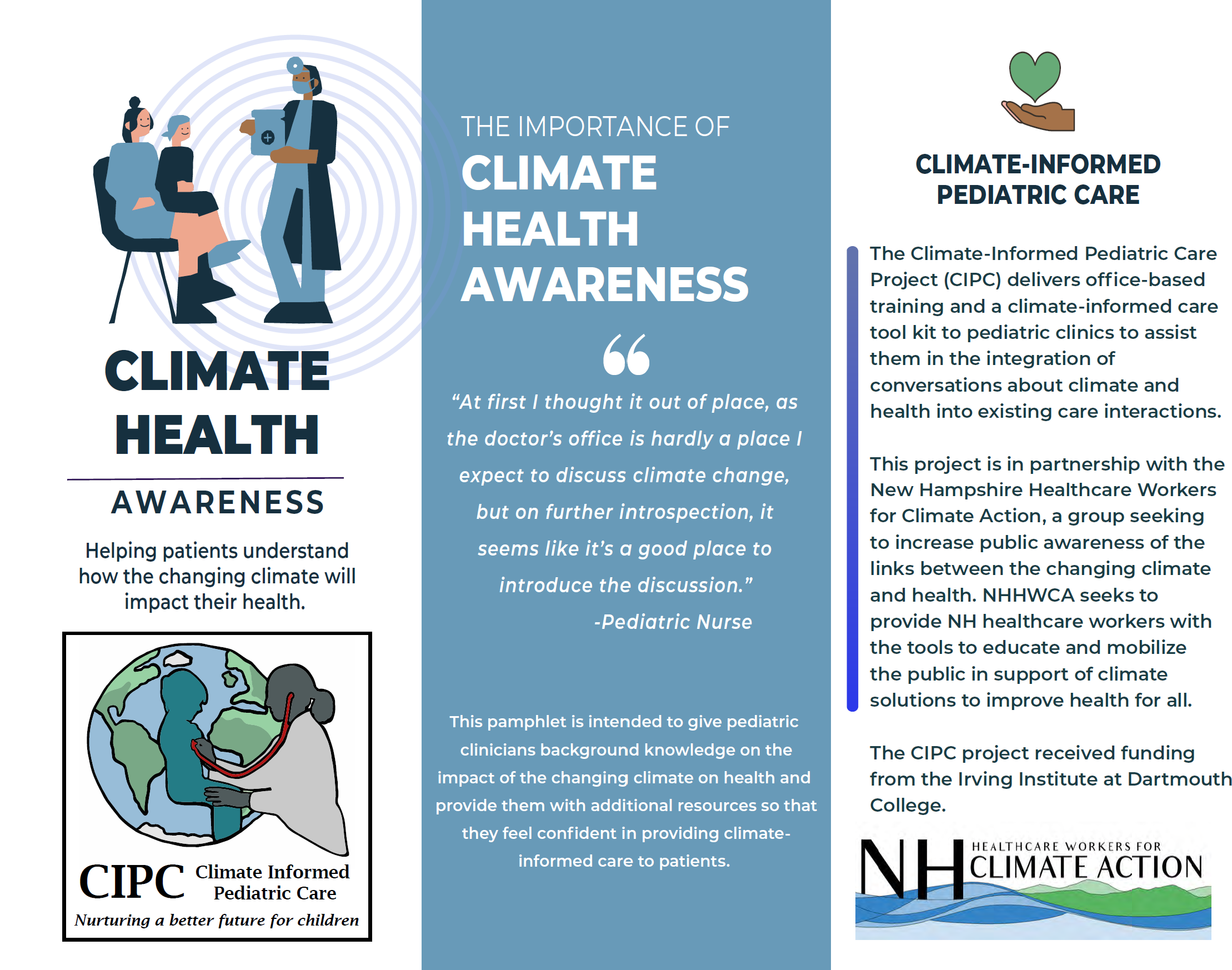
Doctors and nurses who work with kids may be motivated to incorporate climate awareness into their care. With a paper published earlier this month on Climate Informed Pediatric Care (CIPC), Dartmouth and NH Healthy Climate are launching this model for prime time. While the project already trained a number of pediatric clinicians in New Hampshire, the office resources and training materials are now available online for download and use. Dr. Cheryl Anderson, lead author of the study, remarked that “I think CIPC has helped to give busy clinicians the resources they need to discuss climate and health in clinical practice,”... hoping that “with the resources now readily available more practices will start to incorporate the materials into their workflow.”
Families may be interested in checking out NH Healthy Climate’s Healthy Housing Family Resource Guides. The lead author, Matt Cahillane, suggests one win-win solution for both kids and our climate is weatherizing your home, which can reduce energy consumption, save money, and improve your health and comfort. Weatherization can be done more affordably with assistance from groups like NH Saves.
What about individuals? One big ticket intervention is to swap your gasoline powered vehicle out for electric or hybrid, which can reduce your individual greenhouse gas emissions (and associated air pollution) by up to 25%, says Jesse Lore of Green Wave EV, referring to data from the US EPA.
And what can parents do in the doctor’s office? “Smaller interventions that are potentially more accessible,” according to Family Physician Annie Halsey, “include talking with your pediatrician about prescribed inhalers. Metered dose inhalers (MDIs), such as albuterol for asthma, are greenhouse gas contributors, whereas their dry powder inhaler (DPI) counterparts are not. MDIs are much more commonly prescribed, but in many cases a DPI alternative is available.”

Indeed, while climate change can seem overwhelming, actions big and small add up to create a healthier environment for our youngest generation. Read on in this NH CHAT to explore these topics in more depth.