
NH CHAT - April 2026
April 2026
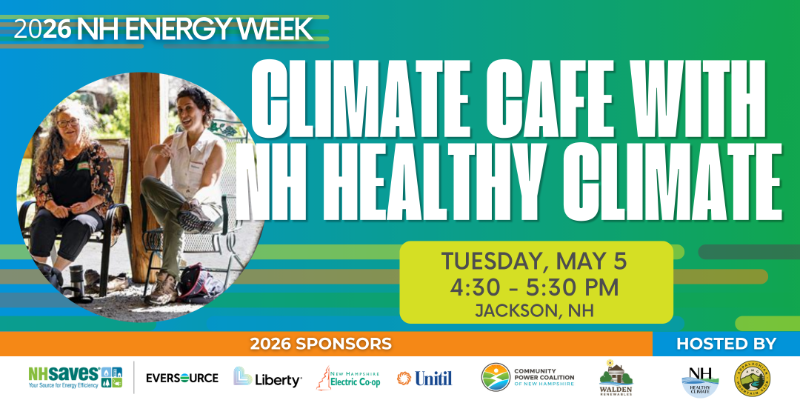
2026 NH Energy Week is almost here! To stimulate conversation and learning about clean energy, NH Healthy Climate is hosting a Climate Cafe at AMC’s Joe Dodge Lodge in Pinkham Notch. Register today to be a part of this important open discussion set in a beautiful place!
New England Heat Pump Accelerator Program
The Accelerator program is a $450 million EPA grant award to leverage the power of a multi-state market to rapidly increase the adoption of heat pumps and heat pump water heaters in single-family and multifamily residential buildings in Connecticut, Maine, Massachusetts, New Hampshire, and Rhode Island.The Accelerator will also tackle barriers to affordable heat pump adoption and promote development of heat pump skill sets in the heating, ventilation, and air conditioning (HVAC), plumbing, and electrical workforce.
Bring affordable heating & cooling to your community
Do you have an idea on how to boost heat pump adoption in your community? A New England Heat Pump Accelerator community grant can give you the resources to put it to the test.
As a next step in the development of the Accelerator, the coalition of 5 states has issued a Request for Information (RFI) for the Accelerator’s community grants.
How community grants work
Community grants provide funding for community organizations and members like you to test innovative ways to overcome local barriers to heat pump adoption, especially in low- and moderate-income households and neighborhoods.
The Accelerator will fund between 20 and 40 grants, each ranging from $100,000 to $400,000, across all coalition states (Connecticut, Maine, Massachusetts, New Hampshire, and Rhode Island).
What ideas grants fund
Community grants will fund a range of projects and programs expanding adoption of heat pumps (air-source and ground-source) and heat pump water heaters.
Possibilities could include testing new approaches to reduce soft costs of heat pumps, train contractor, or test heat pump technology that’s easier to install in multifamily homes.
The Accelerator program is excited to hear what you think would make the biggest difference in your community.
A Request for Information (RFI) period is open now through May 1.
If you have specific questions regarding New Hampshire’s involvement in the Accelerator, feel free to contact Brendan Wyman at brendan.j.wyman@des.nh.gov.
Dr. Bob Dewey: The Benefits of Heat Pumps
The benefits of converting from fossil fuel heat to a heat pump are remarkable; they include: reduced CO2 emissions, improved air quality, improved human health, and considerable cost savings.
Currently 65% of American households heat with fossil fuels. Here is the breakdown:
Methane (Natural Gas) ~50%
Electricity ~38%
Heating Oil ~4-7% (primarily in the Northeast)
Propane ~6% (rural areas)
If we were to replace these heating systems with heat pumps, we would reduce CO2 emissions by over 400 million metric tons annually. This would account for a marked improvement in air quality by reducing PM 2.5 emissions by 300 million tons annually.Converting traditional fossil fuel home heating systems to heat pumps would be equivalent to taking 40,000,000 cars off the road.(1)
In terms of human health, this reduction in fossil fuel pollution could mean 3,400 fewer premature deaths annually and 220,000 fewer hospitalizations for asthma annually.(2)
Finally, because heat pumps are 40% more efficient, there is a significant reduction in heating cost for the consumer. Heat pumps are so efficient, because they neither burn fossil fuels to create heat, nor have a heat element run by electricity. They have a refrigerant gas that circulates through a cycle absorbing and releasing heat as it goes. The refrigerant is compressed and expanded through the cycle causing it to change from liquid to gas and back again. During various phases of this cycle (and due to fluid dynamics and physics) the refrigerant will either absorb or release heat. Some electricity is used to run the pumps and compressors, but not to create the heat.
Bob Dewey, MD
Secretary, Board of Directors
NH Healthy Climate
(1) Rewiring America 2024
(2) American Lung Association 2022

Thanks to you, 2025 was the strongest fundraising year for NHHC to-date. We would not be a leading voice in New Hampshire at the intersection of climate and health without your generous support.
However, we still need additional funding to sustain our critical programs, like NH Healthy Climate Connections K-8 which aims to protect our youngest generations of Granite Staters’ physical and emotional health in the face of a warming climate. Youcan help sustain Climate Connections and all of our climate and health programsby donating today.
Thank you!
Joan Widmer
Executive Director & Treasurer
NH Healthy Climate
Energy Insecurity is a Health Issue

Energy insecurity and energy shortage have major health implications, especially for vulnerable populations like children and the elderly.
That’s why last fall, NH Healthy Climate became a campaign endorser of New England for Off Shore Wind(NE4OSW). We believe we can reduce pollution while investing in reliable, affordable energy that supports healthy living.
Here is the latest on the issue — learn about last month’s press conference in Concord unveiling the findings of a new Union of Concerned Scientists report about offshore wind. Thank you NH Healthy Climate board members Joan Widmer and Bob Feder for representing the healthcare perspective and our organization at the event.
Upcoming Webinars
Join our interactive webinar series with local and national experts in climate and health. Check out Our Events learn more and register for upcoming webinars.
Sign-On Letter: Integrating Climate and Planetary Health Into Education Requirements
In light of the rapidly evolving health impacts of climate change and environmental degradation, we are respectfully urging the Accreditation Council for Graduate Medical Education (ACGME) to explicitly incorporate climate and planetary health into the Common Program Requirements and into specialty-specific Program Requirements, thereby ensuring that all residents are prepared to care for patients in a changing environmental context. Building on the framework proposed in AcademicMedicine, we respectfully request that ACGME consider the following actions:
Incorporate planetary health into the Common Program Requirements.
Embed climate and planetary health within existing competency domains rather than creating a separate silo.
Support specialty-specific implementation while maintaining a common standard.
Leverage existing tools and initiatives to reduce burden on programs.
NHHealthyClimate.org
April 2026
2026 NH Energy Week is almost here! To stimulate conversation and learning about clean energy, NH Healthy Climate is hosting a Climate Cafe at AMC’s Joe Dodge Lodge in Pinkham Notch. Register today to be a part of this important open discussion set in a beautiful place!
New England Heat Pump Accelerator Program
The Accelerator program is a $450 million EPA grant award to leverage the power of a multi-state market to rapidly increase the adoption of heat pumps and heat pump water heaters in single-family and multifamily residential buildings in Connecticut, Maine, Massachusetts, New Hampshire, and Rhode Island.The Accelerator will also tackle barriers to affordable heat pump adoption and promote development of heat pump skill sets in the heating, ventilation, and air conditioning (HVAC), plumbing, and electrical workforce.
Bring affordable heating & cooling to your community
Do you have an idea on how to boost heat pump adoption in your community? A New England Heat Pump Accelerator community grant can give you the resources to put it to the test.
As a next step in the development of the Accelerator, the coalition of 5 states has issued a Request for Information (RFI) for the Accelerator’s community grants.
How community grants work
Community grants provide funding for community organizations and members like you to test innovative ways to overcome local barriers to heat pump adoption, especially in low- and moderate-income households and neighborhoods.
The Accelerator will fund between 20 and 40 grants, each ranging from $100,000 to $400,000, across all coalition states (Connecticut, Maine, Massachusetts, New Hampshire, and Rhode Island).
What ideas grants fund
Community grants will fund a range of projects and programs expanding adoption of heat pumps (air-source and ground-source) and heat pump water heaters.
Possibilities could include testing new approaches to reduce soft costs of heat pumps, train contractor, or test heat pump technology that’s easier to install in multifamily homes.
The Accelerator program is excited to hear what you think would make the biggest difference in your community.
A Request for Information (RFI) period is open now through May 1.
If you have specific questions regarding New Hampshire’s involvement in the Accelerator, feel free to contact Brendan Wyman at brendan.j.wyman@des.nh.gov.
Dr. Bob Dewey: The Benefits of Heat Pumps
The benefits of converting from fossil fuel heat to a heat pump are remarkable; they include: reduced CO2 emissions, improved air quality, improved human health, and
considerable cost savings.
Currently 65% of American households heat with fossil fuels. Here is the breakdown:
Methane (Natural Gas) ~50%
Electricity ~38%
Heating Oil ~4-7% (primarily in the Northeast)
Propane ~6% (rural areas)
If we were to replace these heating systems with heat pumps, we would reduce CO2
emissions by over 400 million metric tons annually. This would account for a marked improvement in air quality by reducing PM 2.5 emissions by 300 million tons annually.Converting traditional fossil fuel home heating systems to heat pumps would be equivalent to taking 40,000,000 cars off the road.(1)
In terms of human health, this reduction in fossil fuel pollution could mean 3,400 fewer premature deaths annually and 220,000 fewer hospitalizations for asthma annually.(2)
Finally, because heat pumps are 40% more efficient, there is a significant reduction in
heating cost for the consumer. Heat pumps are so efficient, because they neither burn fossil fuels to create heat, nor have a heat element run by electricity. They have a refrigerant gas that circulates through a cycle absorbing and releasing heat as it
goes. The refrigerant is compressed and expanded through the cycle causing it to
change from liquid to gas and back again. During various phases of this cycle (and due
to fluid dynamics and physics) the refrigerant will either absorb or release heat. Some electricity is used to run the pumps and compressors, but not to create the heat.
Bob Dewey, MD
(1) Rewiring America 2024
(2) American Lung Association 2022
Thanks to you, 2025 was the strongest fundraising year for NHHC to-date. We would not be a leading voice in New Hampshire at the intersection of climate and health without your generous support.
However, we still need additional funding to sustain our critical programs, like NH Healthy Climate Connections K-8 which aims to protect our youngest generations of Granite Staters’ physical and emotional health in the face of a warming climate. Youcanhelp sustain Climate Connections and all of our climate and health programsby donating today.
Thank you!
Joan Widmer
Executive Director & Treasurer
NH Healthy Climate
Energy Insecurity is a Health Issue
Energy insecurity and energy shortage have major health implications, especially for vulnerable populations like children and the elderly.
That’s why last fall, NH Healthy Climate became a campaign endorser of New England for Off Shore Wind(NE4OSW). We believe we can reduce pollution while investing in reliable, affordable energy that supports healthy living.
Here is the latest on the issue — learn about last month’s press conference in Concord unveiling the findings of a new Union of Concerned Scientists report about offshore wind.Thank you NH Healthy Climate board members Joan Widmer and Bob Feder for representing the healthcare perspective and our organization at the event.
Upcoming Webinars
Join our interactive webinar series with local and national experts in climate and health. Check out Our Events to learn more and register for upcoming webinars.
Supporting Children in a Changing World: Strategies to Address Eco-anxiety and Foster Resilience
Monday, May 4 from
6 - 7 PM
Climate Resources for Health Education: An open access database of climate and health educational materials
Tuesday, June 2 from 6 - 7 PM
Sign-On Letter: Integrating Climate and Planetary Health Into Education Requirements
In light of the rapidly evolving health impacts of climate change and environmental degradation, we are respectfully urging the Accreditation Council for Graduate Medical Education (ACGME) to explicitly incorporate climate and planetary health into the Common Program Requirements and into specialty-specific Program Requirements, thereby ensuring that all residents are prepared to care for patients in a changing environmental context. Building on the framework proposed in AcademicMedicine, we respectfully request that ACGME consider the following actions:
Incorporate planetary health into the Common Program Requirements.
Embed climate and planetary health within existing competency domains rather than creating a separate silo.
Support specialty-specific implementation while maintaining a common standard.
Leverage existing tools and initiatives to reduce burden on programs.
Dr. Darla Thyng: Bi-Monthly Challenge
Spring is here! It is starting to warm-up outside. I notice my heat is not coming on as often.
We typically turn-off our heat around April, and we turn-on our AC in early June. That means our heat pump will switch its circuit and take the heat out of our house, dispersing it into the ground. But for now, we are still having to warm our house.
When NH Healthy Climate Communications & Education Working Group members and I decided to highlight heat pumps in this month’s CHAT newsletter, I decided to research exactly how do these heat pumps work.
Above, Dr. Bob Dewey expains the many benefits of heat pumps, like cost savings and a cleaner energy supply. Here I’m going to explain the basic science.
First, I learned that heat pumps have refrigerants and that the study of refrigerants is called enthalpy. Enthalpy is a type of thermodynamics, and when I saw this word I knew I was in trouble. So I had to go back to Mrs. Frizzle level of envisioning this.
I can’t say that I have the whole process down, even after spending 2 or 3 days looking at online graphs and drawings and talking to people, but here is the way I imagined it:
As a refrigerant molecule, I would travel in a pipe that is burried in my backyard. The pipe is surrounded by dirt that is around 40 degrees. As I flow through the pipe, I too take on a 40 degree temperature. Since my buddies and I are refrigerants, we are very happy and in liquid form at this time. We get a little assist from a pump, and we gently flow along up into a compressor. Here is where we get very stressed and unhappy.
The compressor starts squishing us closer and closer together. We are under a lot of pressure, and we become very hot and energized, as we do not want to be this close. We try to move about crazily, and sure enough, there is a vent pipe for our escape. We turn into hot vapor, and evaporate into the pipe. Next, we travel in our hot vapor form into a contraption called a heat exchanger. This feels great, because it is like sitting on the cool ground or a cool bench in the hot summer. We transfer our heat to the heat exchanger, which then transfers this heat into the house heating system. My refrigerant friends and I breathe a sigh of relief as we cool. We flow to our starting pipes, and without that darn compressor, we are not under pressure. We relax back into fluid, and happily run back under the ground again, returning to 40 degrees. Little are we aware that we will soon begin the journey up again.
Here is my April CHAT challenge:
Look up heat pumps on your own, and learn how they can decrease CO2 emissions and even save money for homeowners.
If you know a friend or family member who needs to replace an old or faulty heater or is building a new home, let them know about heat pumps.
If you have friends that feel uncomfortable about talking in terms of climate change and CO2 emissions, phrase your discussion in terms of cost reductions, ending reliance on petroleum, or just helping our environment. Most people can understand and accept discussions in these terms.
Thank you for reading!
Darla Thyng, MD
Family Medicine Doc
Busy looking up Thermodynamics and Enthalpy.
Rethink, Refuse, Reuse, Recycle.
